
- Get directions
- Call now
- Bookmark
- Share
- Website
- Send an email
- prev
- next
In brief
The scene of ghost sightings for centuries and bursting with a characterful and romantic past, the imprints of both Newstead Abbey's devout and free-spirited former occupants remain indelibly etched onto the fabric of its hauntingly evocative and charged walls.
Category
About
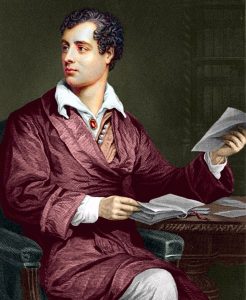
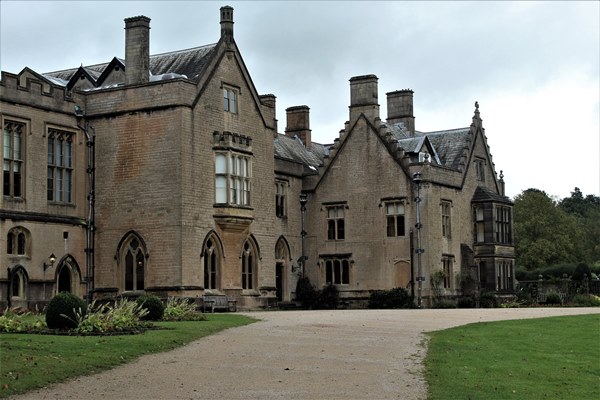
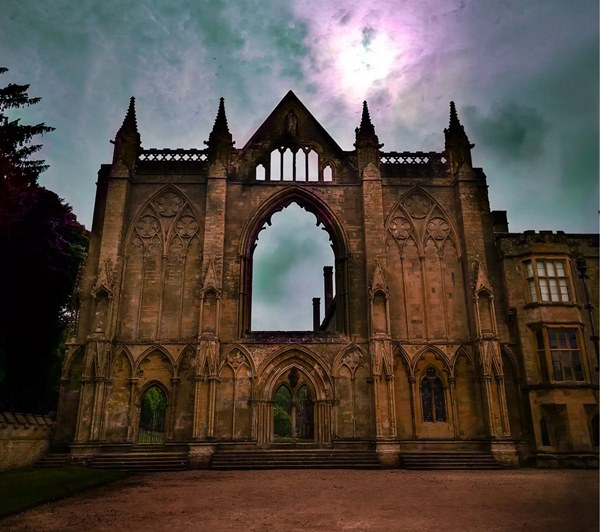
Best known as the ancestral home of the colourful poet Lord Byron, the captivating and famously haunted Newstead Abbey began as a 12th-century Augustinian priory.
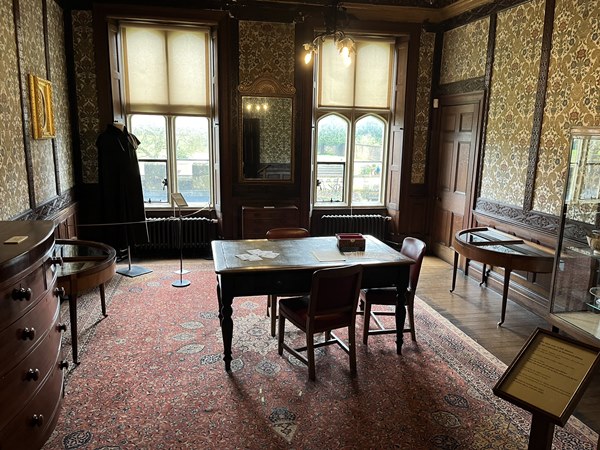
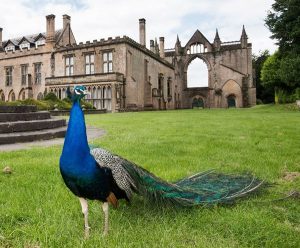
Set within stunning landscaped gardens and lovely peacock-populated grounds, visitors have lots to see, including the poet’s former private apartments, beautiful, panelled rooms, and the original monastic cloisters.
Special events, exhibitions, and guided tours of this superbly designed historic house are available throughout the year.
Packed with fascinating artefacts, furniture, paintings, papers, and property that once belonged to the famous poet, Newstead Abbey makes for a great day out for the whole family.
With a gift shop, car park, and rustic tearoom serving delicious homemade cakes, Newstead Abbey is a definite must-see location for paranormal and history fans alike.
*Video produced by Nottingham Heritage
History
Following hostilities between King Henry II and his former Chancellor and Archbishop of Canterbury, Thomas Becket, the king’s knights brutally murdered Becket in Canterbury Cathedral on December 29, 1170. King Henry vowed that the murder had not been on his orders, and to atone to God for the killing, he founded a priory at Newstead in Nottingham.
It is unclear if a monastery already existed on the same plot, but the Newstead Abbey monastic buildings that survive today were constructed around 1274. The cloisters were added in the 1400s, with later additions built from the stone of the main church building.
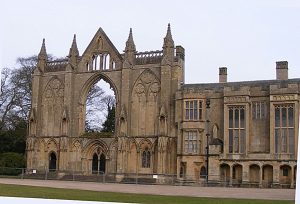
The priory housed an order of Augustinian black cannons, who were so named because of the black hooded habits worn by the monks.
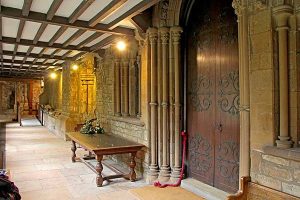
The beautiful architecture and existing buildings provide a tantalising view of monastic life. The remaining cloisters show where the brothers studied, while the kitchen and great refractory attest to where food was prepared and meals were eaten.
Following King Henry VIII’s break with the Church of Rome, Newstead Abbey was seized by the Crown in 1539, and the monks were forced to leave.
It seems that the maverick members of the Byron family, who would go on to occupy the abbey, were not the first residents to show a rebellious and non-conformist streak. Records show that the Archbishop of Canterbury had to make repeated visits to the abbey to discipline the monks and cannons for excessive drinking and a lack of restraint.
Newstead Abbey becomes the Byron family seat
In 1540, King Henry VIII gifted Newstead Abbey to a favoured knight, Sir John Byron, with the strict condition that he demolish the priory church.
Sir John did as he was asked and used the rubble from the original church in the construction of a grand country house. He nevertheless kept the original monastic structure and layout.
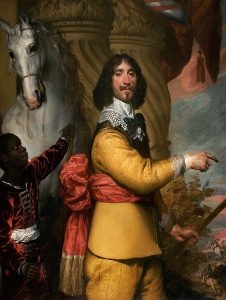
The house passed to successive Byron heirs, and in 1643, in return for his support during the civil war, the original owner’s grandson, also called John, was granted a peerage by the king and became the first Baron Byron of Rochdale.
In 1695, the fourth Baron Byron, 25-year-old William, succeeded his father and took up residence at the abbey. During his tenure, the fourth Lord had an eventful life, marrying three times and producing ten children, four of whom died in infancy.
By the 18th century, the beautiful country property at Newstead Abbey was one of the most lauded grand houses in England.
The Wicked Lord
In 1736, the fourth Lord Byron died at the abbey, with the state and title passing to his son William on his 21st birthday in 1743. The fifth baron proved to be a notorious, eccentric, and scandalous figure who became known as “The Wicked Lord.” He was said to be cruel and violent to his long-suffering wife Elizabeth and his servants, engaging in a string of illicit affairs and self-indulgence while running up a mountain of debts.
Byron proved a disastrous caretaker of his ancestral home, allowing it to descend into a poor, dilapidated state. He had the beautiful ancient oaks felled to sell for wood and liquidated much of the abbey’s valuable contents to help pay debts and fund his decadent lifestyle.
It was during the fifth baron’s tenure that, when work was being carried out on the abbey’s lake, a 15th-century eagle-shaped brass lectern was recovered from the water. Although unsubstantiated, it is claimed that some of the priory deeds and other papers now preserved at Newstead were found hidden in the lectern’s hollow pedestal. It is believed that in 1539, during the dissolution, the priory monks threw the lectern into the lake to prevent its pillage by crown officials. It is because of this that the lake has since been known as Eagle Pond.
Presenting a welcome opportunity to raise much-needed money, William sold the lectern to the cleric Sir Richard Kaye, and in 1805 it was gifted to Southwell Minster, where it remains to this day.
The Wicked Lord gets away with murder
In 1765, while drinking in a London tavern, his lordship became embroiled in a violent dispute with his cousin, William Chaworth. Chaworth owned nearby Annesley Hall, and the pair disagreed about the best way to deal with poachers on their respective estates. Deciding to settle their differences with a duel in a candlelit room, Lord William Byron killed Chaworth by thrusting his sword into his torso.
As a peer of the realm, Baron Byron stood trial for murder at Westminster Hall and managed to escape with a mere fine after being convicted of the alernative offence of manslaughter.
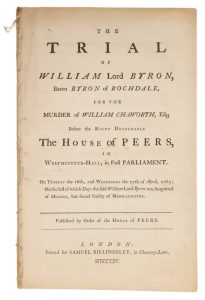
History shows that further allegations and rumours circled the shady fifth Lord Byron, including that he killed his coachman for driving too slowly, threw perverted parties, and worshipped Satan. Furthermore, he purposefully destroyed Newstead Abbey to deprive his estranged son of any valuable inheritance. Whether the latter claim was truth or mere fiction, the outlandish fifth baron outlived all his four children, and so fate intervened to negate any attempts of posthumous, paternal spite.
The bohemian poet Lord George Byron inherits Newstead Abbey
Notwithstanding its long and compelling past, it is undeniably the spirit of the charismatic sixth Lord Byron and poet that enchants its visitors and imbues the abbey with an unmistakable aura of romance, allure, and seductive mystery.
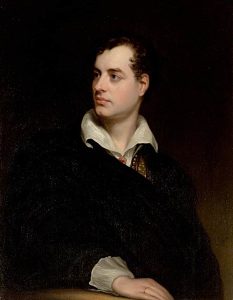
Upon the death of the fifth Lord Byron in 1798, and with no living children to inherit, the title and estate passed to his great-nephew, George Gordon. Ten-year-old George lived in Aberdeen with his mother and had never met his notorious uncle William. Young George’s father had squandered the fortune of his heiress mother, and they lived in modest lodgings.
Upon hearing the news of his inheritance, George and his mother moved to Nottinghamshire, taking up residence in nearby Southwell. The young George fell hopelessly in love with the romantic rambling ruins of the badly neglected Newstead Abbey, which even then appealed to his grandiose visions and extravagant tastes.
Educated at Harrow School and Trinity College, Cambridge, Byron’s first volume of poetry, Hours of Idleness, was published in 1807 and brought him the attention and recognition that were to follow him throughout his life. In the following year, he took ownership of the Newstead estate and title, the abbey having been leased until he came of age.
Lord Byron had accrued enormous debts while at university, and he unwisely cut corners by decorating the Abbey rooms while leaving the decayed roof untouched. His efforts proved pointless as the weather gradually ravaged his improvements. He became convinced that the monks had buried gold at the abbey and had his butler dig up the cloisters. They found no coins, only stone coffins full of bones. Typical of his frolics, Lord Byron had one of the coffins put at the end of the Great Hall to spook the servants.
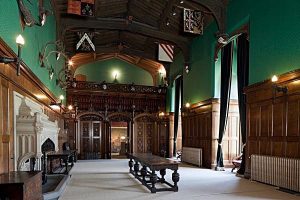
Lord Byron partied at the abbey with his friends from Cambridge, all dressed as monks, as the young bard drank irreverently from one of the skulls they had discovered during the cloisters dig. The graduates fired pistols at targets set out in the dilapidated Great Hall (as now—above), and as Byron was a lifelong animal lover, they were accompanied by his many animals, such as his beloved dog and pet bear.
When he was not visiting overseas, Lord Byron lived at Newstead Abbey until 1814. Around this time, he proposed to and married an aristocrat, Anne Milbanke.
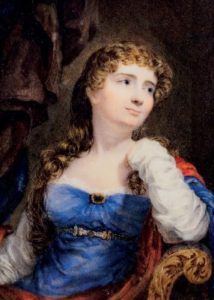
Against a backdrop of huge debts and financial pressures, the union proved disastrous. Lady Byron told of her husband's dark moods, obsessive rituals, and paranoia. With rumours also circulating of his love affairs with both men and women and an incestuous affair with his half-sister, Augusta, the unhappy marriage ended after just one year.
The abbey is rescued
In 1818, after almost 300 years as the Byron family seat, Lord Byron, by now desperate for money, sold Newstead Abbey to a British army officer, Colonel Thomas Wildman. Byron undoutedly felt a deep grief to be parting with his beloved abbey, but his sadness was somewhat tempered by the thought that Wildman, his friend since their Harrow school days, would be its new owner.
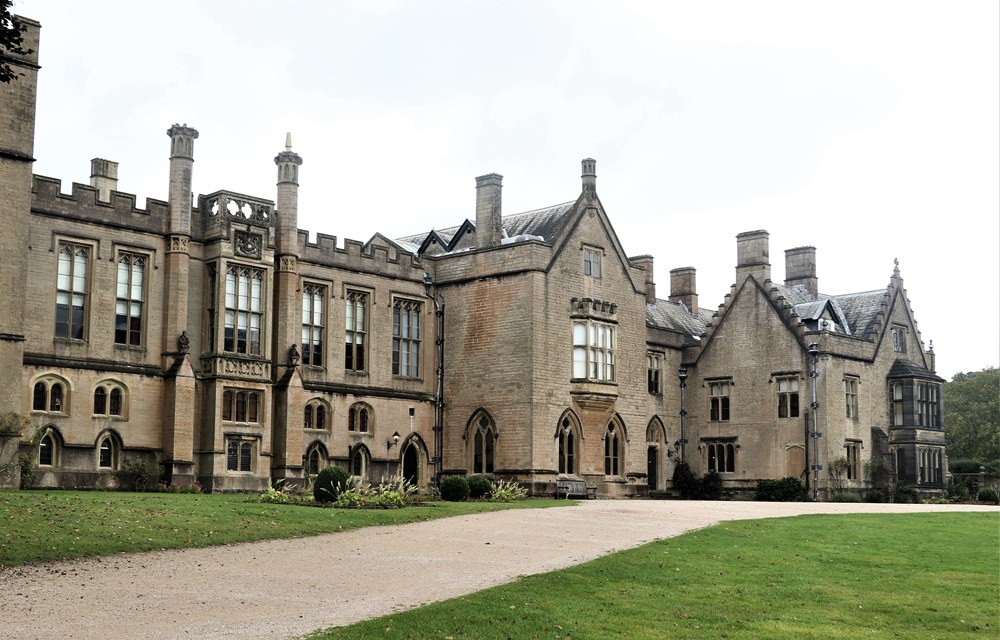
Colonel Wildman turned out to be a true saviour for the crumbling abbey, spending a considerable fortune and dedicating many decades to restoring and rebuilding the neglected house and gardens. The colonel employed the services of Gothic Revival architect John Shaw and added extensions to the property. Much of the present house and grounds reflect renovations carried out by Colonel Wildman (below).
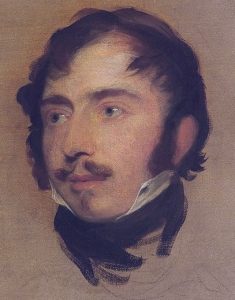
In 1859, after 40 years in residence at his treasured Newstead, Colonel Wildman passed away. The marriage between Colonel Wildman and his Swiss wife Louisa had produced no children, and following his death, Louisa sold Newstead Abbey to explorer William Webb.
Mr. Webb raised his family at the abbey and kept it well maintained, redecorating the chapel but leaving Colonel Wildman’s renovations unchanged. He was a close friend of the Scottish physician and famous fellow explorer, Dr. David Livingstone, who visited and stayed at the abbey from September 1864 to April 1865 while writing The Zambezi and Its Tributaries.
Upon William Webb’s death in 1899, the estate passed to various members of his family until, in 1920, it was inherited by his daughter, Augusta Fraser. Mrs. Fraser was a fiction writer, publishing under the name Alice Spinner. She had fond memories of spending her childhood at Newstead Abbey, and in 1913 she published a memoir, “Livingstone and Newstead,” in which she wrote a fascinating account of Dr. Livingstone’s extended stay at the abbey. In 1925, after just five years as the owner of her childhood home, Augusta Fraser died, and the Newstead estate passed to her son, Charles.
Newstead Abbey is gifted to Nottingham
Charles Fraser was based in Scotland and had no plans to move south to Nottingham. He sold the Newstead estate to Nottingham philanthropist and successful furniture manufacturing magnate, Sir Julien Cahn. Sir Julien wanted to provide the city with some kind of dedication to the much-loved poet Lord Byron, and so purchasing his former home, which still retained many of Byron’s personal possessions and papers, proved the perfect solution. Sir Julien presented Newstead Abbey to the Nottingham Corporation in 1931 on the condition that they care for and maintain it for life and use it as a public tribute to the famous and charismatic poet.
Ghostly activity
- Many visitors describe seeing the ghostly figure of a black cowled monk. There are accounts of a sighting of the monk as early as the 1930s, when a doctor visiting a patient in Newstead village told of getting lost before stopping to ask directions from a robed figure standing in the grounds of the abbey. The doctor claimed that the figure did not speak but pointed him in the right direction. The doctor was later shocked to discover that there had been no monks at the abbey for many centuries.
- Lord Byron maintained that one night, shortly prior to his marriage to Anne Milbanke, he was abruptly woken by a heavy weight of something climbing onto his bed. As he sat up to see the cause, he saw a dark, formless creature with red, blazing eyes staring at him. The terrifying entity then promptly jumped off the bed and disappeared. The creature, known as the Goblin Friar, was said to appear to give advance warning of a disastrous event to members of the Byron family. The marriage proved to be a deeply miserable one, lasting just one year. Was the scary creature warning Byron that his upcoming union with Ms. Milbanke would be one he would regret?
- Lord Byron even mentioned his experience of the frightening goblin creature in his poem Don Juan, writing, "His form you may trace but not his face. Tis shadowed by a cowl: but his eyes may be seen from the folds in between. And they seem of a parted soul."
- In 1920, Augusta Fraser, who had inherited Newstead Abbey, her childhood home, allegedly changed from a sceptic to a believer and maintained that a dark, glob-like, shapeless being with glowing eyes roamed the cloisters part of the abbey at night.
- One particularly fragrant spiritual presence that is frequently reported has been named ‘the Rose Lady’ by staff. The presence has never been known to materialise but presents as a sudden, strong scent of roses and lavender. The scent is usually detected at the bottom of a set of stairs.
- The ghost of a woman wearing a white dress has often been seen walking through the grounds of the abbey. She is such a regular presence that an area of the gardens has been named ‘White Lady’s Walk.’ The apparition is thought to be that of a woman named Sophie Hyatt. Sophie was tragically killed in 1825 in a nearby accident with a horse and cart. She had loved the gardens at the abbey and was such an admirer of Lord Byron’s prose that the abbey’s new owner and friend of Byron's, Colonel Thomas Wildman, allowed Sophie to visit the gardens whenever she wished. Does tragic Sophie return in death to spend time where she was so happy in life?
- A strange and unworldly pillar of icy and fog-like white vapour has been described as suddenly materialising in a corner of one of the wood-panelled bedrooms. The column then mysteriously dissipates from view.
- Sir John Byron is said to haunt the state apartments, with accounts even from the Victorian era of Sir John’s apparition being seen sat in a chair by one of the fireplaces, reading from a large black book.
- A housekeeper known as Nanny Smith, who was employed at Newstead Abbey at the time of poet Lord Byron’s ownership, told of hearing ghostly footsteps while cleaning the dining room. She also recounted a story that, on one occasion, a guest told of seeing a lady in a white dress appear on one side of her bedroom and disappear through a wall on the other side.
- Visitors and staff have reported hearing low, sombre music emanating from Lord Byron’s bedroom.
- The sounds of a ghostly horse and carriage, a band of galloping horses as though with riders, and the sounds of a woman desperately calling out for Lord Byron to speak to her have all been described by unsuspecting visitors enjoying the grounds. Legend has it that the ghostly woman is Isabella, the sister of scandalous William, the Fifth Lord Byron, calling out to plead for a rapprochement.
- After purchasing the abbey from Lord Byron, Colonel Wildman told of hearing the peculiar sound of something heavy being dragged across the gravel outside late one night. He looked out to see the cause, but despite it being a clear, moonlit night, he could see nothing. The Colonel persuaded himself that it must be the groundsmen moving the heavy garden roller. On being asked the following day, the gardeners confirmed that the garden roller had been safely locked away all night and that they had not moved anything or even been present in the grounds at that late hour.
- The ghost of Byron’s cherished Newfoundland dog, Boatswain, is also said to haunt the grounds of the abbey. Upon his death, Lord Byron had buried Boatswain on the site of the Black Canon’s high altar and left firm instructions that upon his own death he should be buried alongside Boatswain. Unfortunately, Lord Byron’s wishes were not respected, and it is alleged that sad Boatswain wanders the grounds looking for his beloved master.
Video
Location
-
Newstead Abbey, Nottingham, Nottinghamshire NG15 8GE, UK
Access
Please note that Newstead Abbey is a Grade I listed property, and wheelchair access is regretfully only available to the ground floor of the house and grounds, including the gift shop and tea shop.
Visitors are welcome to make complimentary use of the house wheelchairs.
The car park is conveniently located close to the house, abbey, shop, and teashop.
Region
A full record of any articles, websites, webpages, books, or other materials that have assisted us in the research and presentation of this listing can be found below.
https://newsteadabbey.org.uk/
‘Newstead Abbey and St Mary.’ Available at https://southwellchurches.nottingham.ac.uk/newstead-abbey/hhistory.php
‘Historic England Research Records, Newstead Abbey.’ Available at: https://www.heritagegateway.org.uk/Gateway/Results_Single.aspx?uid=318057&resourceID=19191
Nanrah, G. (2020) ‘A history of Newstead Abbey and the mystery of its remains.’ 8th July, Nottinghamshire Live. Available at: https://www.nottinghampost.com/news/history/history-newstead-abbey-remains-4306030
Orme, S. (2005) ‘Newstead Abbey - Ancestral Home of the Byrons.’ Available at: https://www.timetravel-britain.com/articles/houses/newstead.shtml
‘William Byron, 5th Baron Byron’ on Wikipedia. Available at: https://en.wikipedia.org/wiki/William_Byron,_5th_Baron_Byron
‘Livingstone and Newstead’ (1913) Spinner, Alice; Russell E. Train Africana Collection (Smithsonian Libraries) J. Murray. Available at: https://library.si.edu/digital-library/book/livingstonenewst00spin
‘The Thoroton Society- Book launches and reviews, Autumn 2008 – Review of ‘The Eccentric Entrepreneur: A Biography of Sir Julien Cahn Bt. (1882-1944)’ Available at: http://www.thorotonsociety.org.uk/publications/reviews/bookreviews19.htm
‘Thomas Wildman’ on Wikipedia. Available at: https://en.wikipedia.org/wiki/Thomas_Wildman
‘Thomas Wildman,’ Twickenham Museum. Available at: https://www.twickenham-museum.org.uk/detail.php?aid=268&cid=16&ctid=1
‘The five ghosts of Newstead Abbey’ (2008) BBC Online, Nottingham, Available at: https://www.bbc.co.uk/nottingham/content/articles/2008/10/08/newstead_abbey_ghosts_feature.shtml
Roberts, L. (2013)’Newstead Abbey is rich with ghost stories,’ 6th February, Chad. Available at: https://www.chad.co.uk/news/opinion/columnists/lee-roberts-guest-column-newstead-abbey-is-rich-with-ghost-stories-2354494
The appropriate copyright attributions for any images and videos included in this listing can be found below.
Apart from those listed below the images of the interior and exterior of Newstead Abbey used on this page are provided with permission of https://newsteadabbey.org.uk/. All rights reserved.
Lord Byron
‘Lord Byron, a coloured engraving’ Artist: Unknown 1873. Source: Noel Collection. Available via Wikimedia Commons. License: Public domain Deed - CC0 1.0 Universal - Creative Commons
https://commons.wikimedia.org/wiki/File:Lord_Byron_coloured_drawing.png

‘Byron 1813 by Phillips.’ Artist: Thomas Phillips, 1813. Source: Newstead Abbey Collection. Available via Wikimedia Commons. License: Public domain Deed - CC0 1.0 Universal - Creative Commons
https://commons.wikimedia.org/wiki/File:Byron_1813_by_Phillips.jpg

Sir John Byron, 1st Baron Byron
‘John Byron, 1st Baron Byron,’ Artist: William Dobson, before 1646. License: Public domain Deed - CC0 1.0 Universal - Creative Commons via Wikimedia Commons, https://commons.wikimedia.org/wiki/File:John1stLordByron.jpg

Lady Byron
‘Portrait of Annabella Byron’ (nee Anne Isabella Milbanke) (1792-1860). Artist: Charles Hayter 1812. License: Public domain Deed - CC0 1.0 Universal - Creative Commons
https://en.wikipedia.org/wiki/Lady_Byron#/media/File:Annabella_Byron_(1792-1860).jpg
.jpg)
Colonel Thomas Wildman
‘Colonel Thomas Wildman,’ Artist: Thomas Lawrence 1831. License: Public domain Deed - CC0 1.0 Universal - Creative Commons
Source:https://commons.wikimedia.org/wiki/File:Colonel_Thomas_Wildman_(1787-1859)_by_Thomas_Lawrence.jpg
_by_Thomas_Lawrence.jpg)
Add a review