
- Get directions
- Call now
- Bookmark
- Share
- Website
- Send an email
- prev
- next
In brief
With ghostly encounters dating back centuries, the spectacular Bolling Hall is justly named one of the most haunted houses in the UK. Steeped in over 600 years of gripping history and blotted with the faded essence of long forgotten lives, this beautiful property is a jewel in any paranormal explorer’s crown.
Category
About
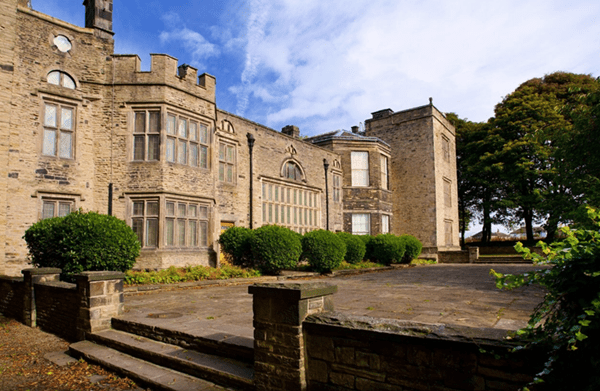
Situated in the middle of a sprawling housing estate just one mile from the centre of Bradford is a beguiling property of remarkable historical and paranormal significance. Well-deserving its notoriety as one of the most haunted houses in the UK, the striking Bolling Hall is one of the oldest buildings in the city.
In a ceremony attended by the local mayor, the hall opened as a museum in September 1915, amidst the backdrop of World War I. Regardless of more than a year of conflict, a staggering 2,500 people attended the first day, eager to learn more of their town’s rich tapestry of history and heritage.
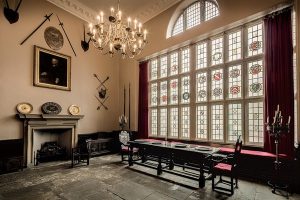
With its pretty gardens and faithfully curated rooms charting the hall’s evolution from medieval house to Royalist headquarters and refined home to Yorkshire’s esteemed Georgian and Victorian families, the hall continues to provide its many visitors with a vital educational resource and captivating testament to centuries of Yorkshire life and history.
History
Listed as the Manor of Bolling in the Domesday Book survey of 1066, the earliest surviving parts of the hall date back to the 14th century, when it was owned by William Bolling. It remained under Bolling ownership until 1502, when Tristram Bolling died, leaving the property to his daughter, Lady Rosamund Tempest, wife of Sir Richard Tempest.
Whilst still in Tempest ownership, Bolling Hall was used as a Royalist base in 1643 during the Civil War siege of Bradford. Following the Parliamentarian victory in 1649, however, the Tempest family paid the price for their royalist support as Bolling Hall was seized by the triumphant side.
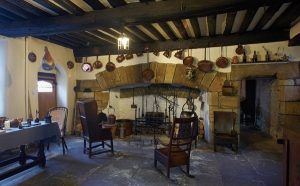
Bolling Hall became the home to various esteemed families in the years that followed. These included Captain Charles and Caroline Wood in the late 1700’s. The Woods' son and heir, Sir Francis Lindley Wood, turned down several opportunities to pursue a career in politics but was an advocate for social reform and the abolition of slavery. He had inherited his uncle’s baronetcy in 1795 and was a keen hunter, keeping many hunting dogs at Bolling Hall.
In 1816, Sir Francis sold the Bolling estate to a local business, Bowling Iron Works, so that coal and iron ore could be mined on the land. A portion of the estate had been sold to the company earlier, but Sir Francis had refused to allow iron rails to be run across the hall's driveway due to concerns they would cause his coach to bounce and cause him discomfort.
Following the purchase, Bolling Iron Works company partner John Green Paley rented out the hall to successive professional tenants such as Bradford Presbyterian, Reverend Nicholas Heineken, magistrate William Walker, and wealthy mill owner James Tankard.
After the Tankard family vacated Bolling Hall in the late 19th century, the Paleys decided that the property would be more useful if the various wings and rooms were divided into multiple tenements and rented out to manual workers. Within around 20 years, the once elegant property was deteriorating and badly neglected.
The Bradford Corporation, worried about the hall's future survival, thankfully came to the rescue in 1912 by purchasing the estate from the Paley family.
The house was carefully restored with beautiful ornate panelling and original features discovered under rudimentary wall coverings, which had been crudely used to divide the hall into separate quarters. The restoration was completed within 3 years, and the hall was opened to the public as a museum in 1915.
Ghostly activity
Bolling Hall is said to be the location of one of the earliest recorded ghost sightings, although the source of any official record appears unknown.
- In 1643, during the civil war, the city of Bradford was supportive of the Parliamentarian cause. The Royalist army, led by the Earl of Newcastle, travelled to West Yorkshire and stopped at Bolling Hall, which was a Royalist base. The outraged earl ordered his soldiers that following a night of rest, their assignment for the following day was to kill all the townsfolk as punishment for their Parliamentarian sympathies and that no man, woman, or child of Bradford should be spared the sword.
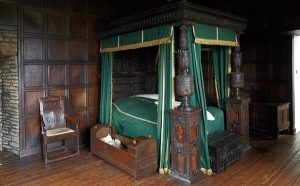
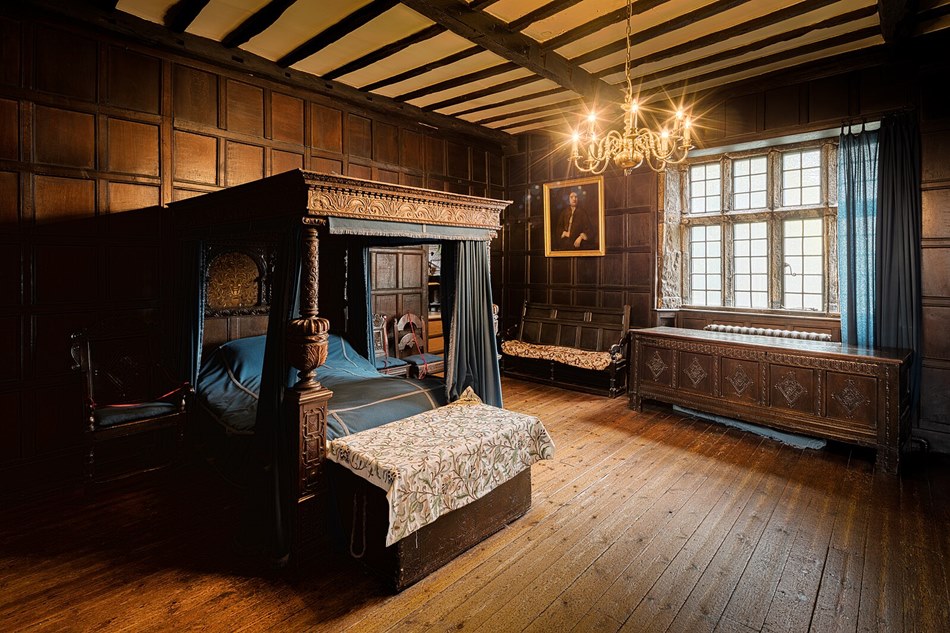
- The Earl of Newcastle would claim on the following day that as he slept in the wood-panelled room, now known as the Ghost Room, he was woken in the early hours by something tugging on his bedclothes. He then saw the ghostly figure of a distressed woman wringing her hands and repeatedly crying, “Pity poor Bradford.” He was so unnerved by the experience that he changed his mind and commanded his soldiers to only kill those who resisted. Thousands of lives were spared because of his last-minute amended instruction. Who was this ghostly woman? Was she really an apparition, or in his half-conscious state did the Earl mistake one of the hall’s servants desperately pleading that he spare the people of her town?
Whatever the genuine source of the 1643 sighting described by the Earl of Newcastle, Bolling Hall has so many reports of paranormal happenings that it has earned a reputation as one of the most haunted houses in the UK.
- A separate early sighting occurred when a maid employed by the Tankard family reported that on her night off, she was crossing the grounds on her way out when she saw a group of civil war soldiers walking towards her. As she got closer, the men simply disappeared. Many reports state this as occurring in 1900, but census records show that mill owner James Tankard lived at the hall in 1881 when three maids formed part of his domestic staff. The Tankard family was no longer living at the hall by 1891.
- The sounds of heavy breathing and of both a baby and a woman crying are frequently heard.
- A head attendant employed at Bolling Hall in the 1940’s also described seeing a woman dressed in period clothing.
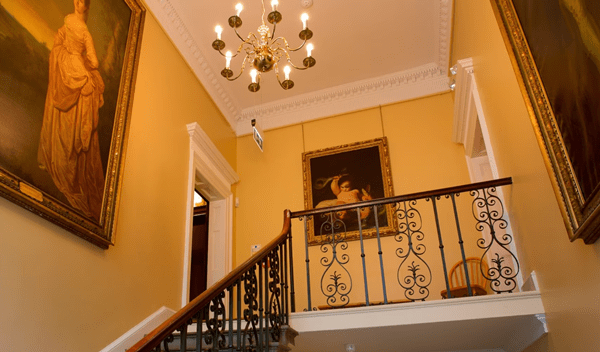
- The ghost of a woman in a black dress and white apron, as though a servant, has been seen often on the stone staircase.
- During a visit to the hall by one of the Ghostly Postcodes team, a young police officer was in reception chatting to a member of the hall staff. As the conversation turned to the ghostly activity, the officer shared an experience when she was on duty late one night. She said that she liked to keep an eye on the hall given its open aspect and the ease with which vandals could access the grounds. Sadly, graffiti on the ancient doors shows that this has happened before. The officer said that as she reached the rear of the hall, she distinctly heard the voices of a group of young children aged around 5-6 years old, singing and happily playing. She was particularly surprised given the lateness of the hour and as she shone her torch from the rear door and across the grounds, the sounds immediately stopped, and all was eerily silent. She searched all around but found nothing. The officer is not alone in hearing the sounds of the phantom children in the grounds of the hall as a number of people have reported the same experience.
- The sudden appearance of a sobbing figure dressed in a white nightgown crossing the galleried landing is said to be responsible for many security guards refusing to work at the hall.
- Crashing sounds and the sound of something heavy being dragged are frequently heard in the main hall with no explanation.
- A former groundsman has been described as interacting with visitors. On one occasion, a couple came to look around the hall and told the staff that they had been the previous day and were disappointed to find that the hall was closed. They described talking to a man wearing a beige or sandy-coloured, knee-length work coat who was busy in the garden. He chatted about the hall and advised the couple to come back the following day. Somewhat confused as nobody had been at the hall on the previous day, the hall staff showed the couple a black and white photograph of a former groundsman wearing such a work coat when planting a tree. The couple identified the man as the one who had spoken to them on the previous day. The groundsman in question had previously worked at the hall in the 1950’s and had long since passed away. Does he still keep an eye on the place he once cared for?
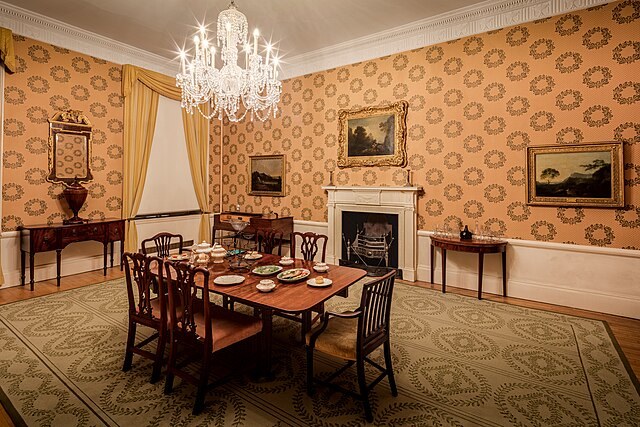
- The sounds of a party or gathering in full swing with laughter and glasses clinking are frequently heard in the dining room. All noises cease once anyone investigating opens the dining room door.
- On the Georgian staircase, powerful and unexplained odours suddenly permeate the air and range from sweaty, unwashed bodies to the pleasant scent of a floral perfume.
- Unsuspecting visitors and staff have also described seeing a ghostly woman on the Georgian staircase. Sometimes she is described as wearing a blue dress; on other occasions, people see the apparition in a pink dress.
- A wooden baby cradle appears to be rocked by unseen hands, and violent banging is heard on the closed doors of empty rooms. Staff have also been left terrified by doorknobs being turned when the hall is empty and closed to the public.
- A frequent sighting in the Blue Room is that of a man with a long, thin grey ponytail, dressed in doublet and hose-type clothing, standing looking into the fireplace with his back to the room. Many people also report feeling unsettled and fearful in this room as though being watched.
- As work was being carried out in the Georgian wing when the hall was closed to the public, an attendant looked up to see the figure of a dark-haired woman in an old-fashioned blue dress standing by the entrance to the drawing room. He followed the figure as she walked through the hallway and up the Georgian staircase before disappearing. The attendant felt that the ghostly figure matched the painting of Caroline Wood, wife of Captain Charles Wood, who owned and lived at Bolling Hall in the late 1700’s.
- The ghost of a stern-looking woman dressed in clothes from the Victorian period appears on a regular basis.
- On one occasion, a member of the hall staff spotted a woman in a 1960's-style dress sitting in one of the chairs. As he approached to let the visitor know that the hall was about to close, the figure simply vanished.
Video
Location
-
Bowling Hall Road, Bradford, UK
Access
Please note that access for wheelchair users is regretfully restricted to the ground floor.
Please call staff on 01274-431826 to gain access via the double doors, which can be reached from the museum car park.
.jpg)
.jpg)
.jpg)
Add a review